
The stimulating effect of the roasted berry of the coffee shrub (coffea arabica) has been enjoyed since the first millennium BC. Coffee plants originate from the southwestern highlands of Ethiopia, and the harvested beans spread through trade with Yemen and across the near east to Turkey. The first records of coffee reaching western Europe are from early 17th century Venice. By the 18th century coffee was a much sought after drink and coffee houses in the main cities of Europe were significant places to meet and carry out business; Lloyds Insurance has its origins in 1688 at Lloyds Coffee House in London.
Throughout the history of coffee consumption, human ingenuity has been applied to how best to extract the flavours and oils from the roasted beans and separating these from the residue coffee grounds. This is possible to achieve by simple manual means if you don’t mind a little bit of sediment in your drink (e.g. Turkish coffee). Many methods and apparatus have been devised for the task of separating the coffee liquid from the grounds, including various siphons and filters. The history of the cafetiere or French press is the story of just one method of separation.
Cafetière à piston
Cafetière is a French noun for a general coffee pot that has come to be associated with a type of infusion device where the coffee grounds are added to hot water, brewed for 3 or 4 minutes and then separated using a filter disc at the end of a plunger rod.
In France the proper name is cafetière à piston and the British usage of the word ‘cafetiere’ for this type of coffeemaker is most likely after the brand La Cafetière which started selling these cafetieres from 1967 onwards in the UK [Ref]. As the popularity of cafetieres has grown, especially since the late 1980s, it has come to have many different names including ‘coffee plunger’ (AUS, NZ, SA) and ‘kaffeepress’ (Germany). ‘French press’ is most common in the USA and has become the most widely recognised reference for the coffeemaker whether in English or a translation (e.g. französische kaffeepresse).
The origins the cafetiere can certainly be traced back to France, with an 1852 patent registered in Paris for a ‘cafetière à pression’. However, devising a filter that separated the coffee grounds efficiently was only fully achieved in 1934, the year of registration of a patent by Gemma Moneta, the culmination of a series of patents connected to the Moneta company of Milan between 1928 and 1934, that progressively perfected the operation of the ‘caffettiera’ coffee pot.
Whilst the critical innovation and first commercial success came in Italy, the post Second World War development of the cafetiere was in France and Switzerland, where heatproof glass was first used and the well-known lantern like design of a glass cylinder, held in vertical metal bands and a domed lid was first produced.
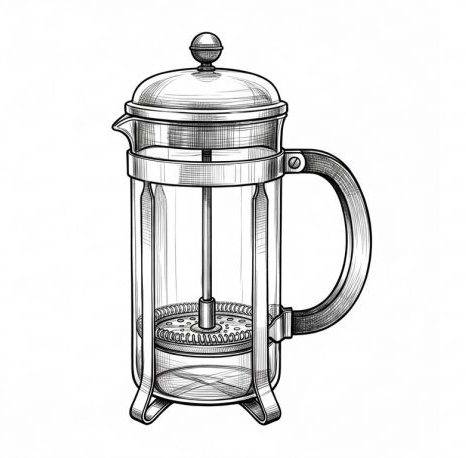
A typical cafetiere as rendered using an AI creator from the words ‘pencil drawing of French press’
In the beginning – a cafetiere foundation myth
Like all the best ideas, the cafetiere has its own foundation myth that provides a sort of just so story about how a problem with sediment in the coffee was solved. The story goes like this…
… an old Frenchman took a daily walk to escape his nagging wife. He took with him a coffee pot to brew coffee over an open fire. On one occasion he forgot to add the coffee until after the water had begun to boil and the grounds would not settle, making for an unpleasant drink, full of sediment. By a stroke of good fortune, a merchant was passing by, who had with him a metal mesh screen. The old man bought a small section of the screen, fitted it inside the pot and using a stick, pushed the grounds to the bottom. The two men shared the coffee and agreed it was the best they had ever tasted… they decided to open a small factory; the beginnings of the piston coffeemaker …

The story captures the imagination, and some details appear to prefigure actual historic records of a patent for “une cafetière à pression et à filtrage instantanés” (a coffee press with fast filtering) filed in Paris by Henri-Otto Mayer and Jacques-Victor Delforge on March 27th 1852 [ref.]. However, this first filter design used cloth as the filter and use of wire mesh is only recorded in 1929 – the story of the old man is probably an invention.
Mayer and Delforge cafetière à pression, 1852
The patent diagram clearly shows a coffee pot with a plunger device, and the benefit of this coffeemaker was the same as today; a fast and simple method of separating the unpalatable coffee grounds from the infusion. The only issue with this ‘cafetière à pression’ is that it probably did not work very well. The critical element of a cafetiere is the filter, what it is made of and how well it separates the sediment from the coffee. The Mayer and Delforge patent only refers to ‘flannel’ or some form of suitable filtering cloth and there was no means described of ensuring a good seal between the filter disc and the walls of the coffee pot. As a result, it is likely that an excessive amount of sediment will have escaped the seal, resulting in a rather gritty cup of coffee, full of sediment.
.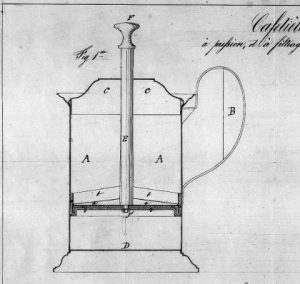
Image extract of Cafetière à pression
et à filtrage instantanés
Patent number 13301
Mayer, Delforge registered 27.03.1852
Other similar piston coffeemaker inventions
Caféolette – Louis Forest
The idea of using a filter to make the preparation of coffee simpler has attracted numerous inventors and an exploration of Google Patents relating to improvements to coffee and tea pots lists over 24 inventions between 1877 and 1923. Notable among these are several piston coffeemakers; in around 1913 there is ‘Caféolette’ for making café au lait invented by a French writer and journalist called Louis Forest. Forest invests considerable effort in popularising his method of coffee-making and publishes a booklet in 1913 entitled, “L’Art de faire le Café au lait a l’Ancienne – subtitled “à l’aide de la Caféolette Louis Forest”.
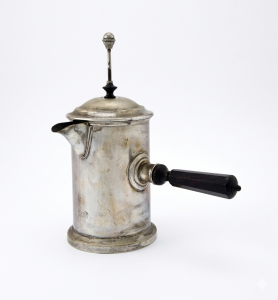
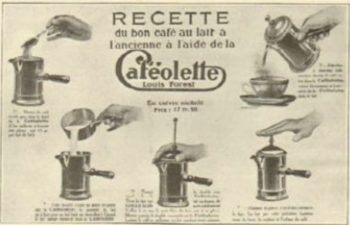
Caféolette – inventor Louis Forest c. 1913
Filtre-presseur à café, thé et toutes infusions – ‘Jolbert’
In 1924 another Frenchman, Marcel-Pierre Paquet (known as Jolbert) Ref, published a patent for a “filter press for tea, coffee and all infusions”. The patent diagrams show an elegant coffee pot incorporating a piston with a series of three interlocking and pierced filter discs, a little like today’s cafetieres. The filter itself is made using silk. Like the earlier Mayer and Delforge patent coffeemaker, there is no means to ensure a close fit between the filter disc and the wall of the container to stop coffee grounds from entering the liquid infusion.
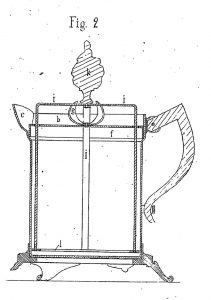
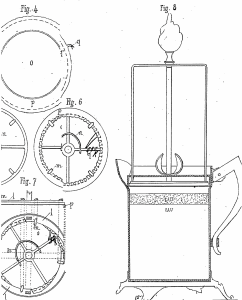
Image extract from
Filtre-presseur a café thé et toutes infusions
Patent number FR 575729 A
Paquet registered 11.01.1923
The invention of espresso and Italian café culture
In 1884 Angelo Moriondo [Ref] of Turin is granted a patent for a “new steam machinery for the economic and instantaneous confection of coffee beverage.” This is generally regarded as the first patent for an espresso machine, with further improvements by Luigi Bezzerra and Desiderio Pavoni patented in Milan 1903. These patents were originally intended to speed up the coffee making process and in fact created a whole new style of coffee – espresso. These early espresso machines helped establish the commercial retailing of coffee in cafés and mark the beginnings of Italian café culture.
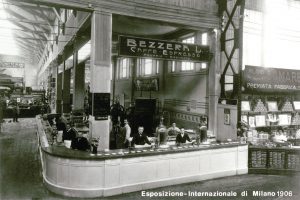
Bezzera espresso coffee machine exhibited at the Milan International Fair in 1906 [credit www.bezzera.it/en/bezzera#history]
The influence of Mussolini in the development of two famous coffeemakers
With the development of espresso machines coffee shops became an integral part of Italian society, so much so that Mussolini imposed a tax on these machines in public bars from 1927 onwards with the aim of reducing gatherings in cafés through increased prices. The effect was to encourage coffeemaking at home using existing methods such as the ‘Neapolitana’, an inversion coffeemaker, poplar in Naples (hence the name) and invented by Frenchman Jean-Louis Morize in 1819 [Ref].
Discouraging gatherings in coffee bars also had the effect of encouraging innovation. Two famous coffeemakers were invented at around the same time; a stove top coffeemaker launched by Alfonso Bialetti & Co in 1933, eventually becoming famous as the Moka Express in the 1950’s [Ref]. And a piston coffeemaker, that became famous as the Melior Patent Caffettiera, with a patent first registered by Attilio Calimani and Giulio Moneta [Ref] in 1928 for ‘apparatus for preparing infusions, particularly for preparing coffee.’ This is the starting point for the modern cafetiere.
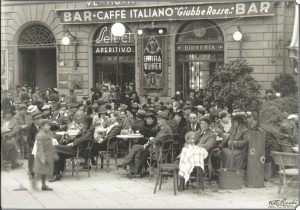
Bar Caffè Giubbe Rosse, Florence, early 20th century [credit https://earthstoriez.com]
Moneta Company of Milan and the Melior Patent caffettiera
In 1875 Giuseppe Moneta started a company in Milan making metal housewares which continues to this day as Moneta brand cookware (part of the Italian Alluflon Group since 1986) [Ref]. In the early 1920’s his two sons Alessandro and Giulio Moneta became managing directors of the Moneta company. In around 1928 the Moneta company took an interest in designing a coffeemaker with a patent registered to Attilio Calimani and Giulio Moneta [Ref]. This first patent also refers to Ugo Paglini as assignor who may have given rights to or sold his idea to the Moneta company (previously sig. Paglini had patented a tomato press in a French registered patent of 1922).
This first Calimani and Moneta registered patent for an infusion coffeemaker is barely an improvement on the earlier Jolbert design (which they may or may not have been aware of) with the main difference being the inclusion of a ‘coiled spring’ that helped to maintain the position of the plunger rod in the pot. The filter itself is only described loosely as ‘a rigid perforated screen.’
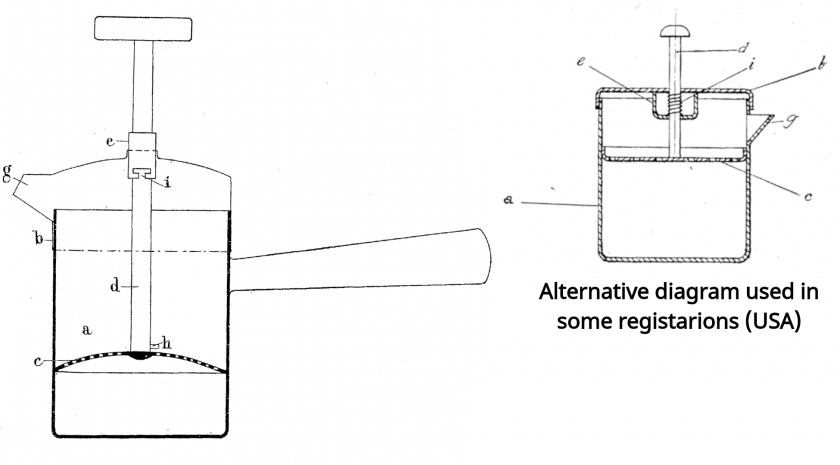
Image extract from
Improvements in coffee pots
Patent number UK 308,993
Ugo Paolini assignor of one half to Attilio Calimani and one half to Giulio Moneta
Application registered 02.04.1929
Original Italian application registered 02.04.1928
Calimani and Moneta appear to have been dissatisfied with this design as a little later a second patent is registered, on 27th October 1929 [Ref]. In this patent the filter has been redesigned as a sort of round cassette, with features to stop the filter gauze from clogging. However, these two early patent registrations did not include a way of ensuring a seal between the edge of the filter part and the wall of the cafetiere. This said, the designers clearly had a degree of confidence in the potential of their coffeemaker and continued filing patents of improved versions.
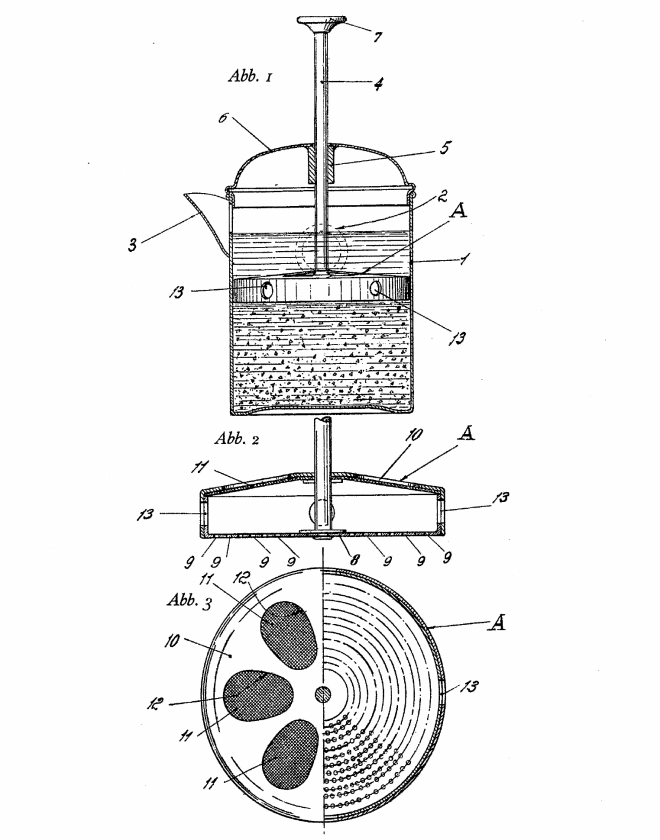
Image extract from
Device for preparing infusions, especially coffee drinks
Patent number DE 537 714
Attilio Calimani and Giulio Moneta
Application registered 27.10.1929
The issue of sediment escaping past the filter edge is first addressed with a patent application on November 25th, 1931, [Ref] which includes design changes made to the round cassette filter assembly. There is the addition of a groove around the periphery of the cassette in which a rubber ring is placed to act like a type of O-ring seal:
“The invention consists in providing the piston-like filter around its periphery with resiliently deformable sealing means, such as one or more split rings of any form, or a helically coiled spring or the like, or a solid or hollow rubber ring or rings, which prevent liquid from leaking past the periphery of the filter and permit the filter to be pressed down by a moderate amount of force.”
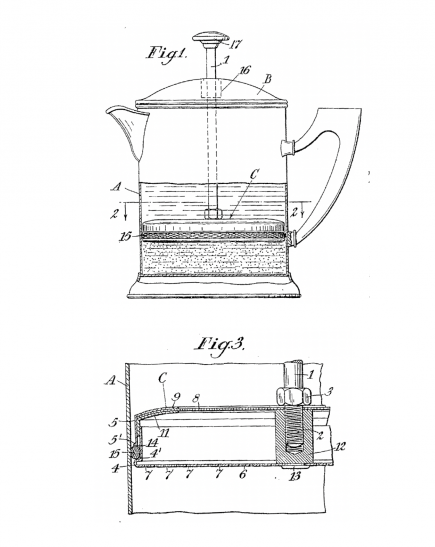
Image extract from
Apparatus for the Preparation and Quick Filtration of Infusions and especially Coffee
Patent number FR 726 878
Attilio Calimani and Giulio Moneta
Application registered 25.11.1931
This design appears to have worked moderately well as there is advertising and surviving examples of Moneta caffettiera using this filter system.
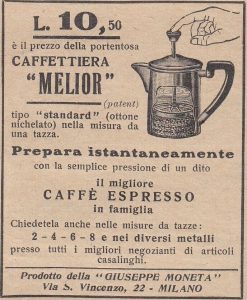
Image extract 1932 Italian newspaper advert
As early as 1932 there are newspaper advertisements for the Melior cafetiere in France offering the product for sale and also seeking agents to sell this new type of coffeemaker.
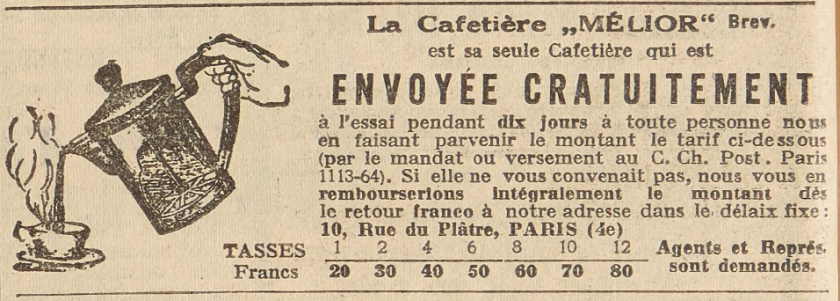
Image extract 1932 Les Dernières Nouvelles de Strasbourg 14.02.1932 newspaper advert, France [Ref]
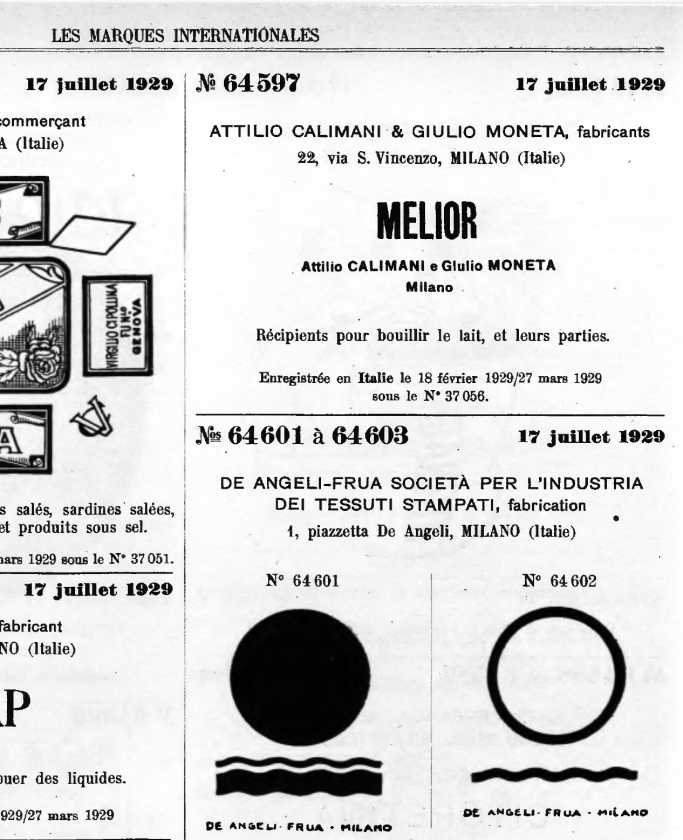
The name given to this coffeemaker made use of the Latin word for ‘better’ – Melior. On 17th July 1929 Calimani and Moneta, publish the MELIOR trademark in Les Marques Internationales [ref], as a brand for ‘receptacles for boiling milk and suchlike’. The Melior brand soon became famous for a type of coffeemaker pre- Second World War. By the end of the twentieth century Melior was a byword for cafetieres in many countries. It is still a trademark of Bodum (PI Design-AG).
Image extract from Les Marques Internationales 17.07. 1929
Recepticles for boiling milk and suchlike
Trademark number 64597
Attilio Calimani and Giulio Moneta
Application registered 18.02.1929
.
The 1934 Gemma Barelli Moneta and Bruno Cassol patents – the invention of the modern cafetiere filter
Only in 1934 was the problem of the leaky seal was finally solved with a patent first registered in Italy on 2nd March 1934. The application was made by Gemma Barelli Moneta [Ref] for “an improved filter for filtering coffee or other infusions or liquids.” Later in 1936 a very similar patent application is registered with the US patents office by Bruno Cassol. The applicants were both closely connected with the Moneta company; Gemma Moneta was the wife of Giulio Moneta, and Bruno Cassol was the Moneta family driver. Their involvement with the later innovation is a little unclear; either they were the inventors or they made the registrations as convenient representatives for the company (perhaps for reasons to do with individual ownership or tax efficiency?*) Whatever the reason, the later patents were to the benefit of the Moneta company.
(*Personal communication with Paulo Moneta, 2024)
Image extract from
Improved Filter for Filtering Coffee or other Infusions or Liquids
Patent number GB 448 883
Gemma Barelli Moneta
Application registered 27.12.1934
Convention date Italy 2.3.1934
Image extract from
Apparatus for Filtration of Infusions
Patent number USA 2,053,021
Bruno Cassol
Application registered 26.2.1935
Assignor to Gemma Barelli Moneta (transferring his rights to Gemma Moneta)
The 1934 Gemma Moneta/Cassol design solution
The 1934 patent fully describes and illustrates the modern cafetiere filter arrangement; two pierced circular discs ‘sandwich’ a wire gauze, the outer edge of the gauze is held against the wall of the cafetiere using a spring which is threaded through tiny holes around the periphery of the upper disc and this forms the seal which prevents sediment escaping with far more efficiency than previous designs.
This new filter arrangement is both brilliant and simple, it uses the properties of a spring that can compress and expand to its usual state – not just from one end to the other, but also along its length at each coil. By threading a spring in and out of holes around the perimeter of the filter disc, the edge of the filter can expand and contract to conform to the inside of a coffeepot cylinder as the plunger rod goes up and down. When wrapped with a wire gauze, the filter maintains an efficient seal preventing sediment from escaping into the coffee liquid. The patent diagram is a diagram of the modern cafetiere filter system. Problem solved.
Image extract from similar patent applications
Patent number GB 448 883 (Gemma Barelli Moneta) 27.12.1934
Patent number USA 2,053,021 (Bruno Cassol) 26.2.1935
Convention date Italy 2.3.1934
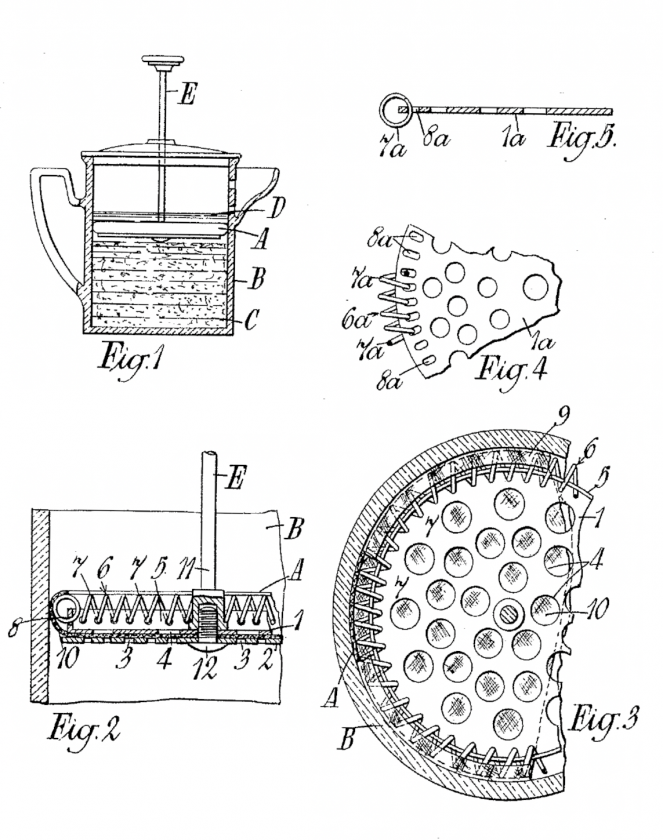
In this patent it is also noted that glass or ceramic is to be considered an ideal material for their coffeemaker,
“In the particular case of the preparation of coffee, it is known that it is advantageous to use vessels constructed of vitreous or ceramic materials in preference to metallic vessels.”
The Moneta company made caffettiera in both metal and ceramic, however, the use of heatproof glass was not realised until 1951, after a world war and a change of Melior brand ownership to a French company.
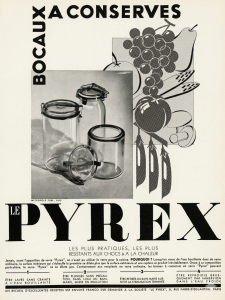
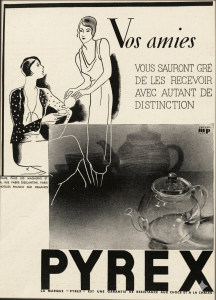
Newspaper adverts for Pyrex France 1932
1930’s success of the Melior Patent caffettiera – ‘The Coffeemaker That Triumphs All Over the World’
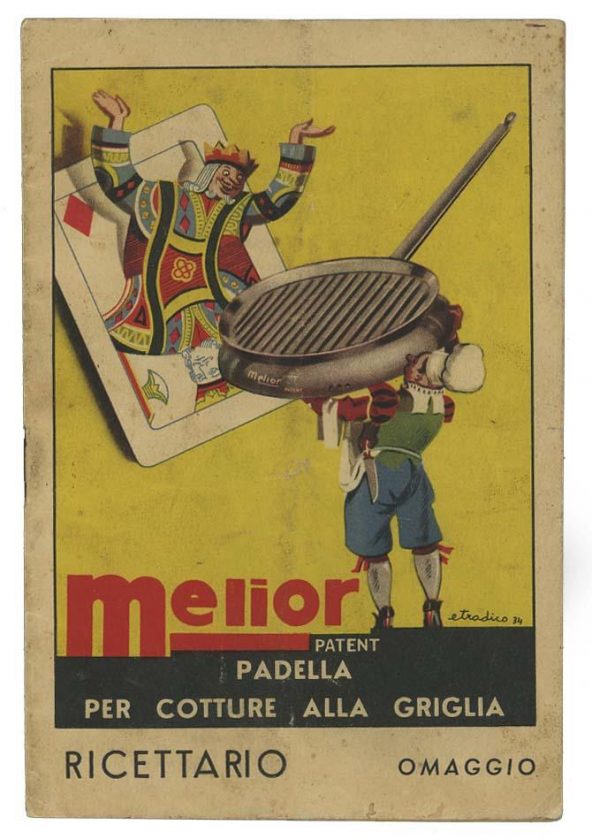
The Giuseppe Moneta Company manufactured a range of Melior brand of goods and marketed these in Italy, France, Germany, Switzerland, the UK, as well as north Africa during the 1930’s. The Melior brand range included various household items; pans, coffee grinders, grills and notably the Melior Patent Caffettiera.
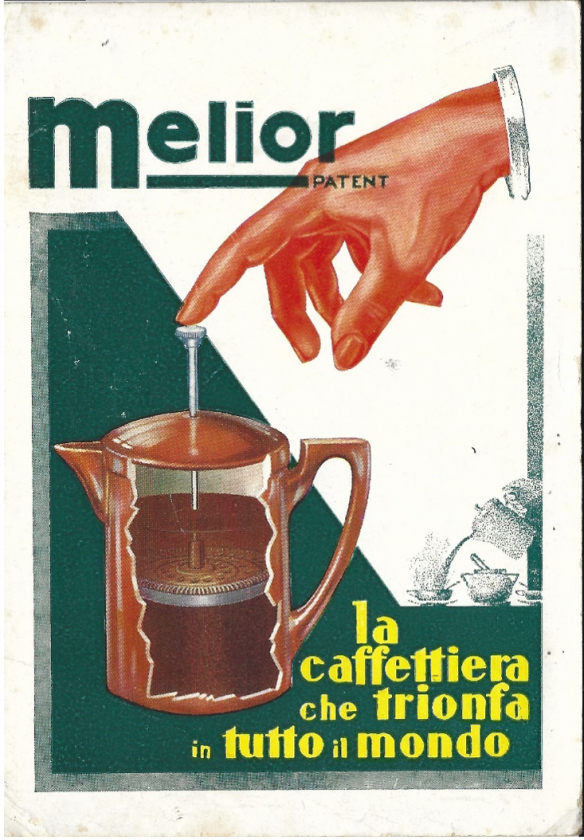
Melior Patent caffettieras were clearly successful and in 1935 a postcard proudly declares, ‘Melior Patent. La caffettiera che trionfa in tutto il mondo’ – Melior Patent – the cafetiere that triumphs all over the world
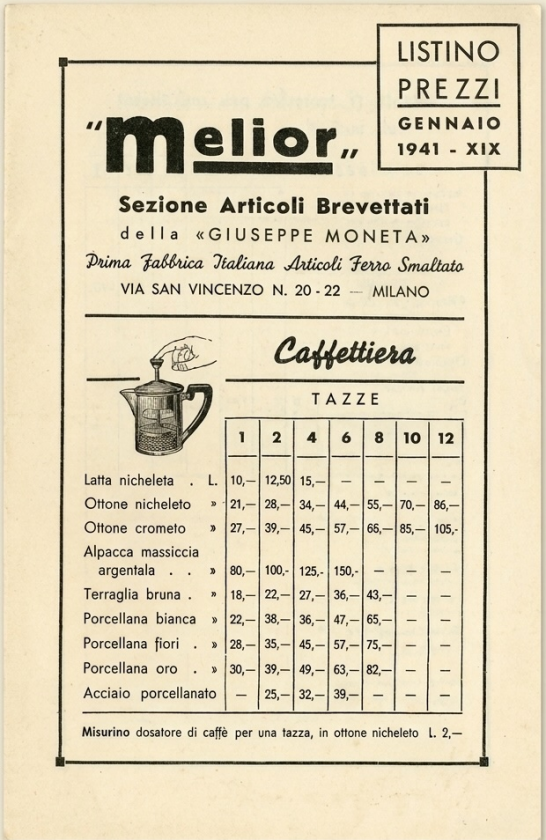
A Melior price list from 1941 illustrates the caffettiera product range that include 44 variants in different materials and product sizes.
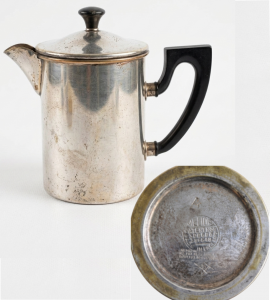
Metal versions were in nickel or chrome plated brass and tin and there was also a silver-plated coffeemaker.
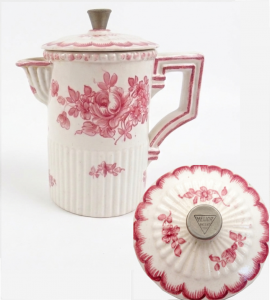
Ceramic versions were in simple brown earthenware and also different patterns of porcelain.
The sizes of the caffettieras were measured in cups, just as todays cafetieres with 1, 2, 4, 6 8, 10 and 12 cup versions – and possibly the starting point for some confusion about just what a cup is?
Melior Patent coffeemakers were sold in the UK during the 1930s, with Booths of Tunstall (Stoke-on Trent) making ceramic forms and silverplate versions being manufactured under licence as surviving examples are marked as ‘Made in England.’
The Moneta company invented the modern cafetiere, but it was only in the 1950’s that the appearance took on the recognisable form
The cafetiere filter design was created in the 1930’s, however, the Melior Patent caffettiera of the 1930’s in its overall appearance and form does not look like todays cafetieres; the pronounced spout, use of metal or ceramic and a broader or shorter appearance looks distinctly different from a typical modern cafetiere, often made with heatproof glass held in a framework of metal or plastic. The appearance of these ‘form factors’ happens later in the early 1950’s.
Moneta Company and Italy in wartime turmoil: Heroism, Loss and Escape
The Melior Caffettiera was invented during the time of the National Republican State of Italy (1922-43) and may even have been partly in response to Mussolini’s tax on coffee machines in commercial premises. The nature of Italy’s fascist state was different to that of Germany, whilst not especially tolerant of Jews, there was an accommodation.
In July 1943 Benito Mussolini’s government was overthrown and in response, German forces seized control. They rescued Mussolini from captivity and installed him as leader of a puppet government commonly known as Repubblica di Salò, which occupied northern and central Italy from September 1943. This change in regime added a further terrible impact of war on many, including those closely connected with the Moneta company.
Alessandro Moneta (1883-1945), the brother of Giulio is listed in the Room of Names commemorating the dead of Mauthausen Concentration Camp [Ref]; he was assassinated at Gusen on January 20th, 1945. Alessandro Moneta was arrested for offering assistance and hiding places to Jews in the Moneta factory and country residence.
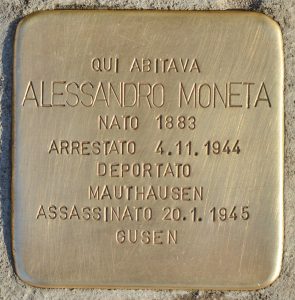
Credit image Wikipedia
Bruno Cassol, who registered the 1936 USA patent and is recorded as inventor, was killed in a car accident in 1944 whist driving one of Giulio’s sons between the factory in Milan and the family residence in Varese. He was very close to the family, and his two daughters were offered employment by the company to give them a more certain economic future*.
*Personal communication with Paulo Moneta, 2024)
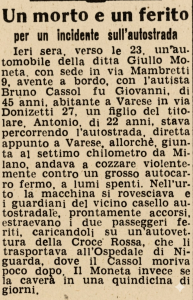
A newspaper report of the accident from 13th December 1944.
Attilio Calimani who registered the first patents with Giulio Moneta in the late 1920’s and early 1930’s, was Jewish, and the Prefecture of Milan records show that his property was confiscated in January of 1944 with a revocation in June of the same year, the reason given was that the assets were registered in the name of his wife. On 5th January 1944 Attilio Calimani escaped Italy for Switzerland, when his arrival as a refugee is recorded.

Record extract from www.ushmm.org
Post 1945 – Melior brand and product manufacturing rights are sold to a French company Société de Façonnage et de Commerce (SFC)
Soon after the Second World War, there was a reorganisation of the Moneta company, and the Melior brand caffettiera and cooking grill business was sold. The exact reasons for the sale are unclear, but the effect of the sale was to streamline the company’s manufacturing back towards metal products including enamel pots & plates, road signs, military helmets and car parts*.
Milan trademark registrations show a renewal of the Melior trademark on 8th January 1944, however, by 1948 Melior cafetieres and cooking grills are being advertised in France by a company called Société de Façonnage et de Commerce (SFC) with a Paris office at 2 rue Dunois in the 13eme quarter.
From 1948 onwards there is French newspaper advertising for two Melior brand products, cafetieres and cooking grills. These resemble the caffettiera and grills first made and sold by the Moneta company until the mid 1940’s. The advertising refers to the previous popularity of the cafetiere by stating ‘as before the war’ or ‘comme avant guerre’.
* Personal communication with Paulo Moneta
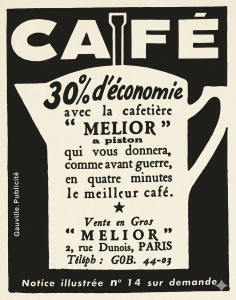
Le Figaro newspaper advert from 27th December, 1948
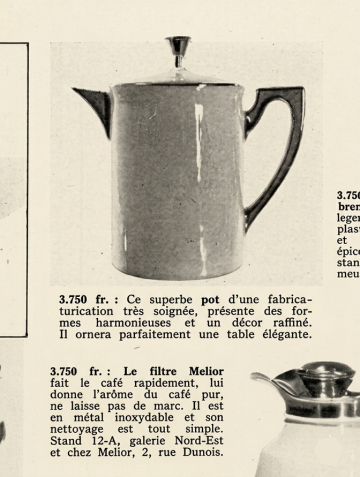
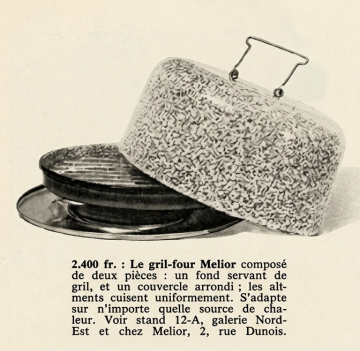
Elle L’Hebdomadaire de la Femme magazine 19th February 1951
There appears to be active and substantial investment in these Melior products by the new owners SFC, with advertising in various periodicals including Elle L’Hebdomadaire (now better known as Elle) and national newspapers including Le Figaro. These marketing campaigns include offering free recipe booklets by return of postal requests. There is also investment in the products themselves with improvements made to the cooking grills (a patent for a grill lid registered by a certain Faliero Bondanini, October 1953)
Most significantly for the history of the cafetiere, is an advertisement for the first Pyrex glass version of the Melior cafetiere in 1951 which was to evolve into the form that can be recognised in today’s cafetieres.
The first Pyrex glass model of the Melior cafetiere appears to be very similar in form to the previous ceramic and metal models with a large spout and elaborate handle. This first model must have had a short lifespan as a second model of Melior Pyrex glass cafetiere is also advertised in 1951.
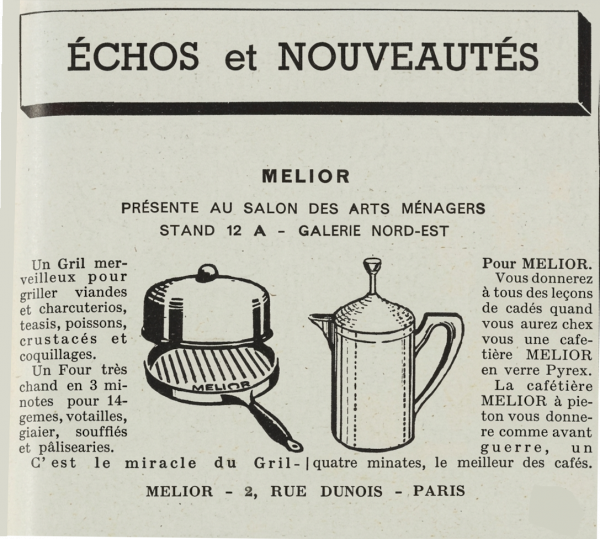
Extract from France Illustration March 1951 [Ref]
This second Pyrex model looks more like today’s cafetieres and contains many recognisable features of the familiar cafetiere form: a tall glass body with a small spout, set in a chrome framework, a simple C-shaped handle and a step-domed lid with a plunger rod emerging from the top. At its base, the cafetiere is held in a sort of metal cup, indicating that at first the designers wanted to ensure good protection for the glass body.
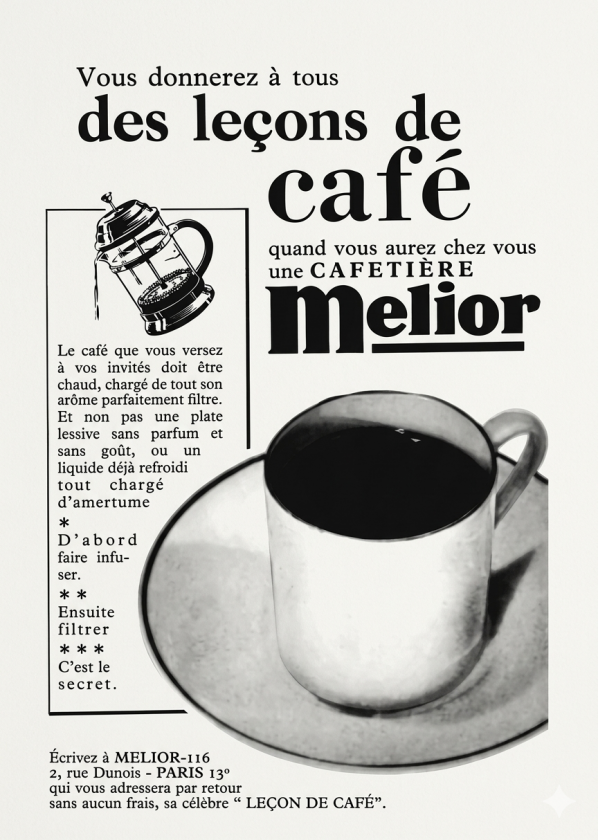
Extract from La France a Table 1st December, 1951 [Ref]
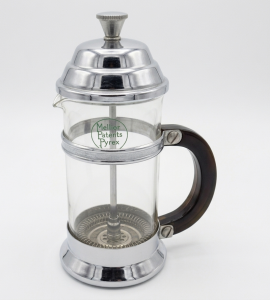
Image of Melior Patents Pyrex 1951 – c. 1959
A similar looking Melior cafetiere was produced using Schott Jena heatproof glass with a shallow domed lid and open handle similar to Moka pots, and this was sold until around 1958.
In addition to glass models, by 1955 there is advertising for a new aluminium body version of Melior cafetiere called ‘Club’ and this addition to the range may have been to provide an alternative to the aluminium bodied Moka Express which was rapidly growing in popularity.
The ‘Club’ cafetiere appears to have been short-lived. Later in the 1970’s the ‘Club’ name was reused for a plastic and glass model cafetiere that was presumably more affordable.
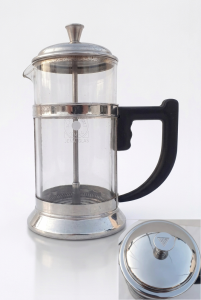
Image of Melior Patent cafetière
made with Jena Shott heatproof
glass c. 1956
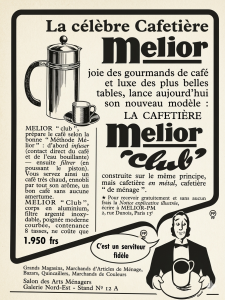
Image of advertisement for Melior Club
aluminium cafetière c. 1955
A third Pyrex model is advertised from c.1959 and this updates the Pyrex design with the entire glass body being supported by a more elegant chrome framework consisting of four vertical bands that cross beneath the base of the cafetiere and formed into loops that act as ‘feet’. This model also had a C-shaped handle and a step domed lid as before, and the plunger rod was now topped by a spherical knob. This cafetiere is branded as Melior Patents Pyrex on the glass and advertised with a new sub-brand name of ‘Chambord’ after Château de Chambord, King Francis I’s hunting lodge completed in 1547. Chambord is a French byword for quality and opulence that has been used by a range of different products and services. The appearance of the cafetière also looks a little like the roof lanterns on the castle’s conical towers, perhaps also prompting the name.
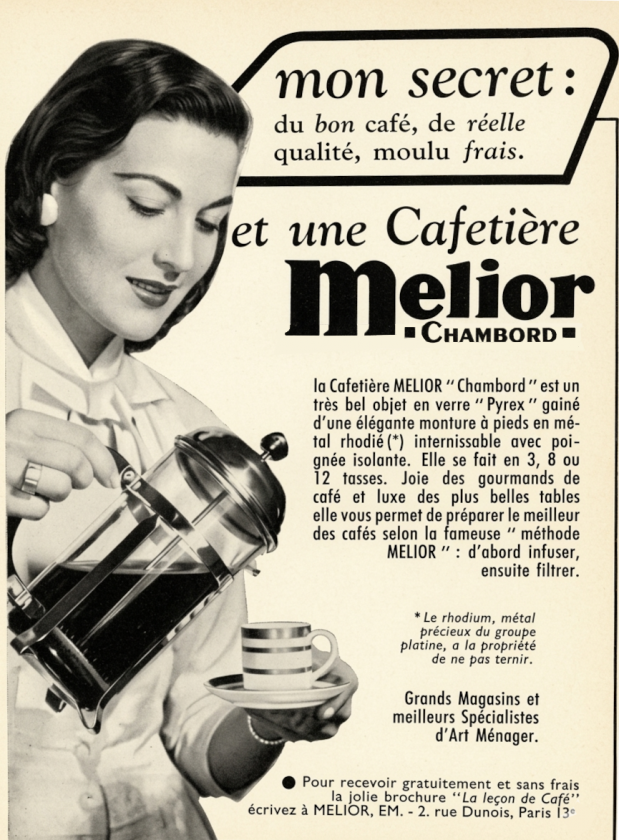
Melior Chambord advertising c. 1959
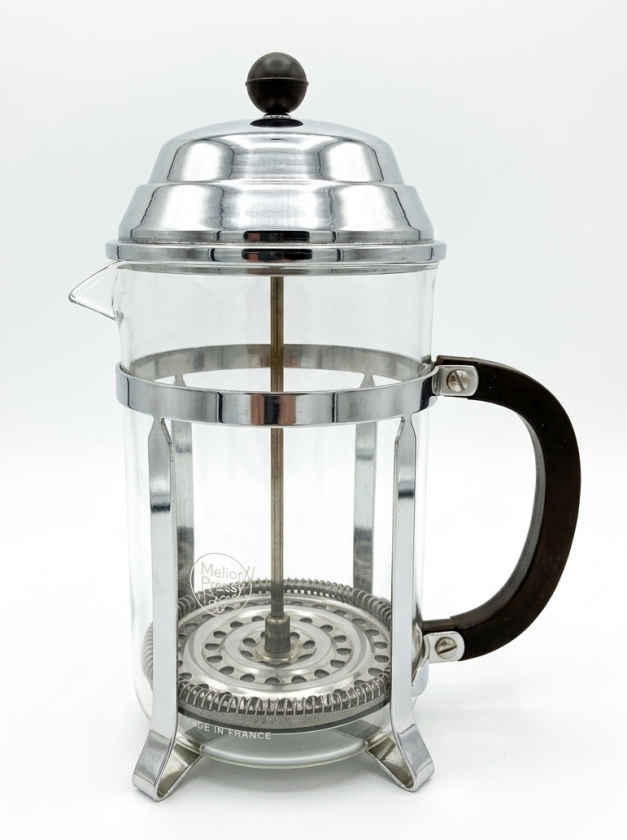
Image of Melior Chambord from 1959
The later development of Melior Chambord circa 1963
Later in around 1963 this Chambord model was updated to have a smooth domed rather than step-domed lid. During the 1970’s the Chambord name was no longer used for Melior cafetieres, but the name did re-emerge for versions of the cafetiere made in plastic in the 1980’s. In August 1991, Bodum, part of PI Design-AG acquired the Melior business [Ref], and the Chambord brand name was once again used to differentiate Bodum Chambord from its other cafetiere coffeemakers, with the Melior brand being used for a selection of other products.
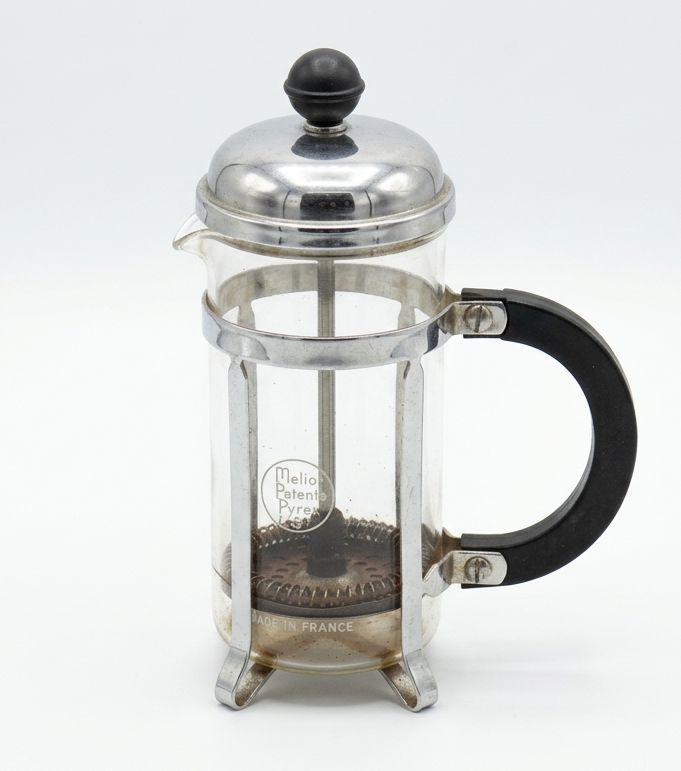
Image of Melior Chambord from 1963
The role of Faliero Bondanini in the development of the cafetiere between 1933 and 1985
In an account of the history of Melior cafetières there is a brief description of how a Swiss Italian called Faliero Bondanini (b.1907- d.1987) attended the fifth international Triennale exhibition in Milan of 1933 and came across the first Moneta Melior caffettiera, which must have ignited his interest in this type of coffeemaker. The exhibition was mostly a showcase for grand architecture, however there may well have been smaller related exhibitions for other innovations where Melior Caffettieras may well have been showcased, as these new coffeemakers originated in Milan and were being sold at this time.
By September 1934 Faliero Bondanini was involved as an agent or distributor of Melior grills and cafetières in Switzerland. He advertised in a number of Swiss newspapers, inviting readers to visit his exhibition stand at the annual Comptoir Suisse national fair based in Lausanne, Switzerland:
The great advice given to those with fine taste is to buy the MELIOR grill and coffee maker. 19415. At the Comptoir Suisse, Stand 869, Hall 7, a free tasting. F. Bondanini, Lausanne.
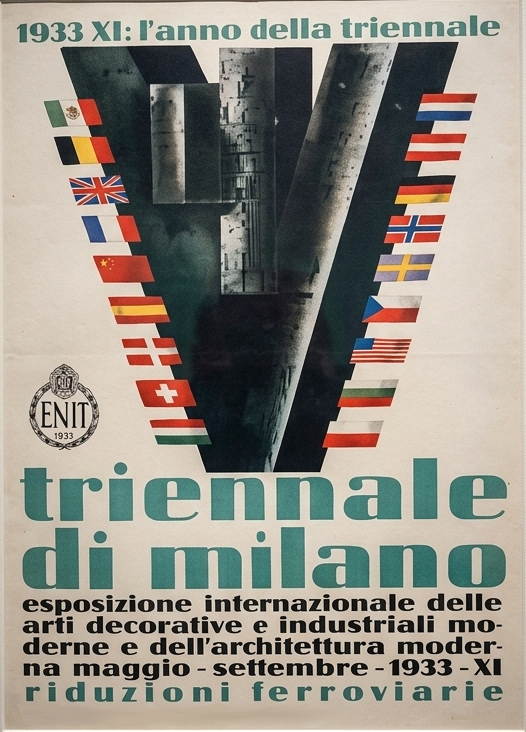
Image extract of poster for 5e Trienniale di Milano
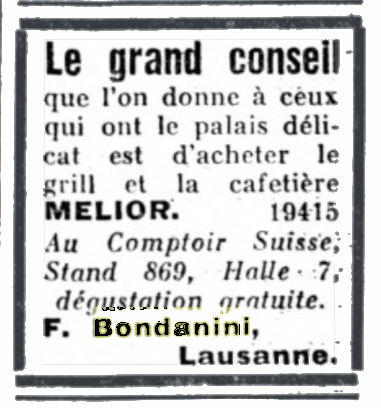
Image extract from La Liberté (Switzerland), 14.09.1934 Ref
Faliero Bondanini – entrepreneur inventor of household articles
An exploration of historic patent registrations reveals that Faliero Bondanini was an inventor/ entrepreneur from Lausanne, Switzerland with around 50 patent registrations in a career spanning from 1934 to 1984; the first for ‘electric pressing irons’ and his last a Japan patent registration or renewal for ‘a filter for a coffee percolator.’
Bondanini’s patent filing activity includes some diverse household items: a cooking grill in 1947, a device for putting an egg in patisserie in 1949, a floor mop in 1950 and a tray for germinating seeds in 1953. The 1947 cooking grill registration was followed by two 1953 registrations for an improved cooking grill and a lid for a cooking grill. These closely resemble a Melior ‘gril four’ which was often advertised alongside SFC’s other significant product, the Melior cafetiere. It appears that Faliero Bondanini was working in some capacity with Société de Façonnage et de Commerce (SFC) and Melior brand products.
In addition to this. Faliero Bondanini was also marketing some of the same products in Switzerland by another company, Établissements F. Bondanini, Renens.
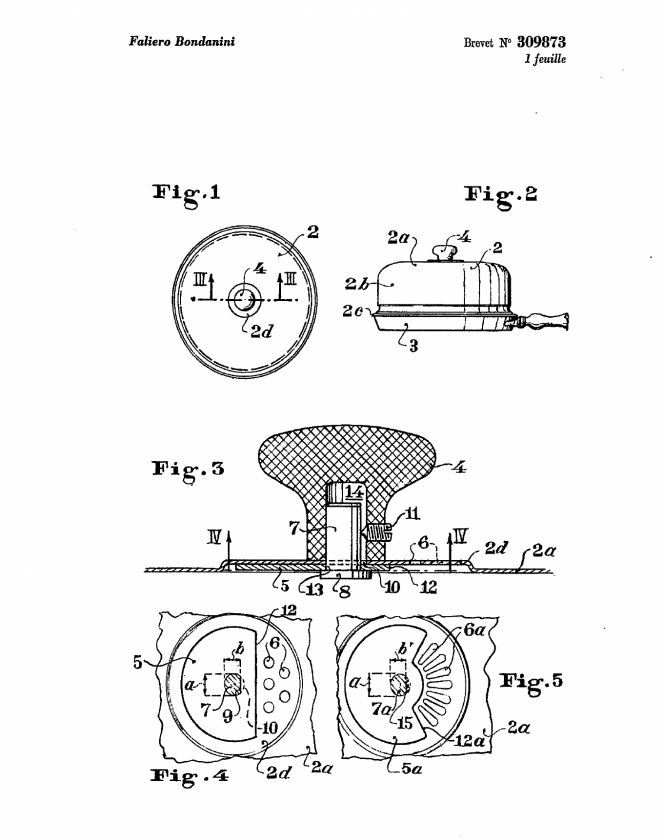
Image extract from
Couvercle pour utensils de cuisine
Patent number CH 309 873
Faliero Bondanini
Application registered 14.10.1953
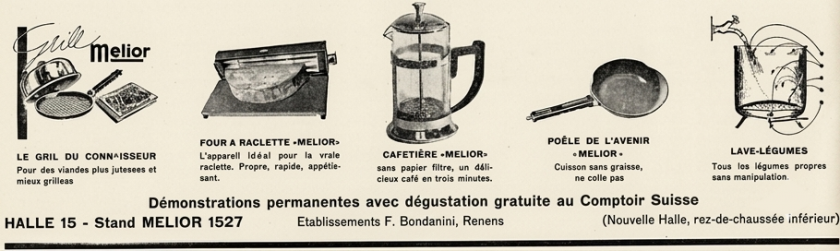
Image extract from L’impartial newspaper (Switzerland), 19.09.1958 [Ref]
A 1950s patent registered by Faliero Bondanini for a cafetiere filter
Many accounts of the development of the cafetiere attribute final later design improvements to Faliero Bondanini based on a USA patent published in 1959. [Ref]
Earlier than this, in 1955, Faliero Bondanini made a series of patent registrations in Switzerland, France and the UK for Apparatus for the preparation and the filtration of infusions [Ref]. These registrations are some time later than the existence of the heatproof glass Melior Patents Pyrex cafetiere of 1951.
Faliero Bondanini’s improvement is most clearly characterised by a series of metal ‘tongues’ around the perimeter of the filter disc, that were intended to ensure the filter mesh is held against the coffeemaker wall, to prevent sediment escaping. This improvement essentially replaces the need for a coiled spring around the filter disc of the Moneta-Cassol filter registered in Italy in March 1934 [Ref]
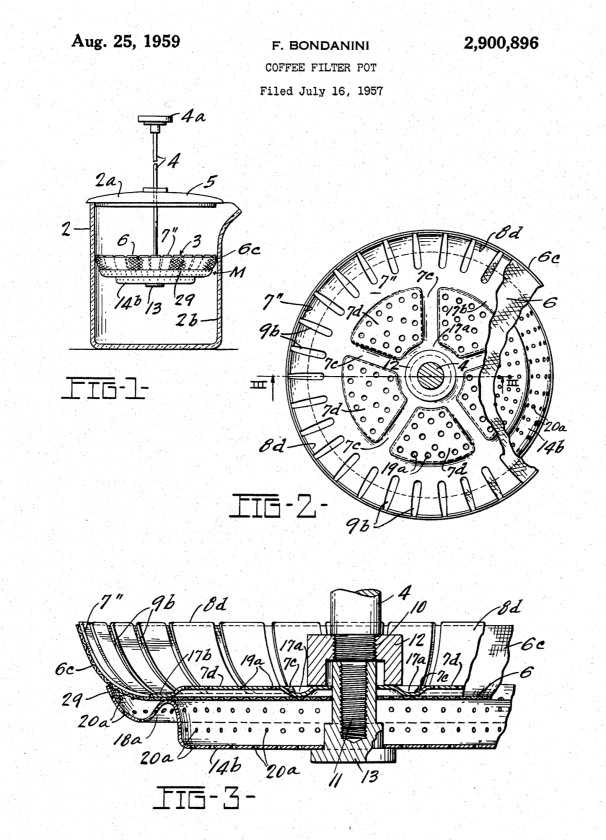
Detail from patent drawing showing the ‘free flexible tongues’
Image extract from: Coffee Filter Pot
Patent number US 2,900,896
Faliero Bondanini
Application registered 16.7.1957 patented 25.8.1959
Application Switzerland 25.02.1955
The use of ‘tongues’ is a clear, distinctive and inventive feature described in this 1955 patent registration. However, it’s a feature that does not appear to have been used in cafetiere filter design in the 1950’s or later. If the design was manufactured, it did not supersede the Moneta-Cassol filter that is still the most common filter arrangement in use today.
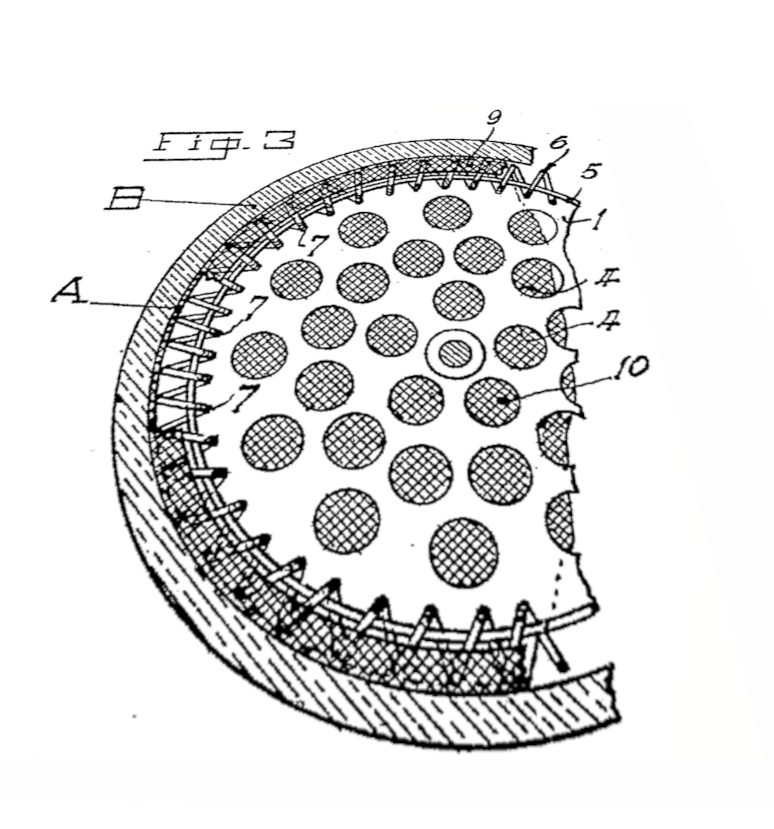 Gemma Moneta Swiss patent drawing 1934
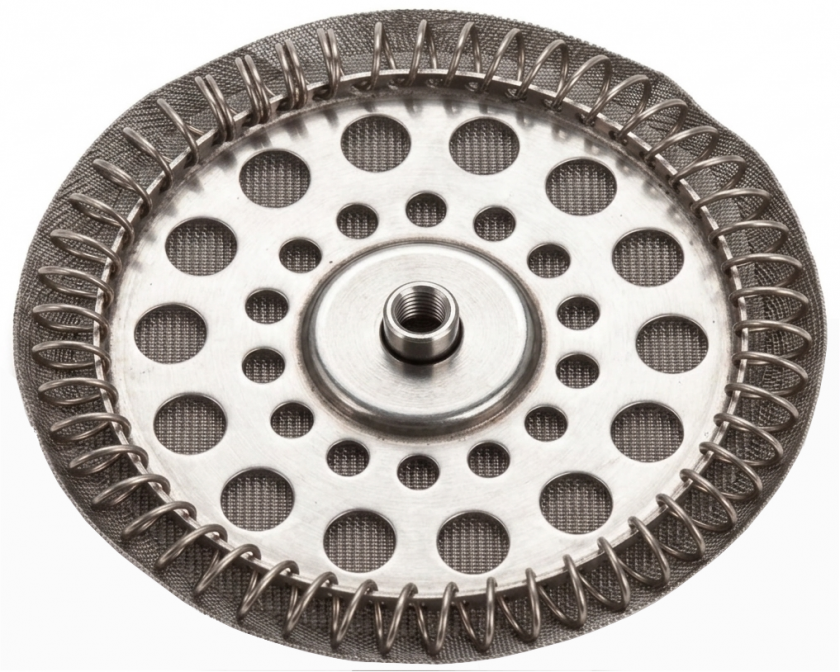
A modern replacement filter section
A 1950s mystery to solve …
Why this patent was filed is a little mysterious as a perfectly good filter design was already present in Melior cafetieres. The existing design was not replaced with a ‘new improved’ filter of metal tongues, and a coiled spring around the periphery of the filter remains the most common filter in use today.
Melior cafetieres of the 1950’s had ‘Melior Patents Pyrex’ boldly printed on the coffeemaker glass and a patent protectable design was clearly important to the manufacturers. However, by the 1950’s Pyrex was not protected by patent, and nor was the Gemma Moneta and Bruno Cassol patent of 1934, as the US patent registration of US8390A expired on 1st September 1953. So, was the Faliero Bondanini patent filed to extend protection for Melior cafetieres? If so, the only flaw in this strategy seems to be that the later design was never used.
Faliero Bondanini is an influential figure in the history of cafetiere French press in actively promoting this new type of coffeemaker
To pick up the story again, Société de Façonnage et de Commerce (SFC) acquired the Melior business form the Moneta company in around 1948 and advertised Melior brand cafetieres and cooking grills in French publications from that date.
From the late 1950’s there are references to another company, Martin SA, or to give its full name Société Anonyme Des Anciens Établissements Martin which was closely connected to SFC and became the parent company of the Melior business (SFC was legally ‘absorbed’ into Martin SA in 1983).
With a little further exploration, it’s possible to identify the location of the SFC/ Martin SA factory as the village of Velaines near Bar-le-Duc, 240km to the east of Paris. Here a range of different products were manufactured listed in a contemporary economic review as, musical instruments (clarinets), cooking grills, cafetières, world maps and re-packaging glue for the French market (a then famous brand originating from Belfast, ‘Seccotine’).

Extract from Revue Géographique de l’Est Vol 1 No 4, October to December 1961, superimposed on photo of Velaines factory from 2024.
It is unclear what role Faliero Bondanini served with Martin SA in the 1950s or the exact relationship with the then parent organisation SFC. However, it appears that he was closely involved in the design, manufacturing and marketing of the first heatproof glass cafetiere designs, known first as Melior Patents Pyrex and by 1959 given an additional name of Chambord.
In addition, Établissements F. Bondanini was also actively marketing many of the same Melior brand and other products in Switzerland during the 1950’s.
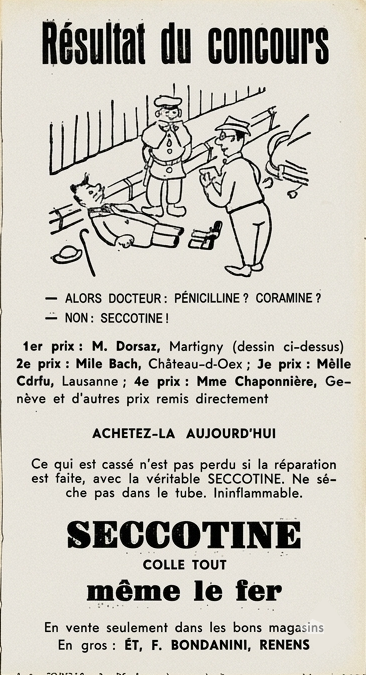
Image extract from Le nouvelliste, Switzerland, Volume 48, 12.09.1958 [Ref]
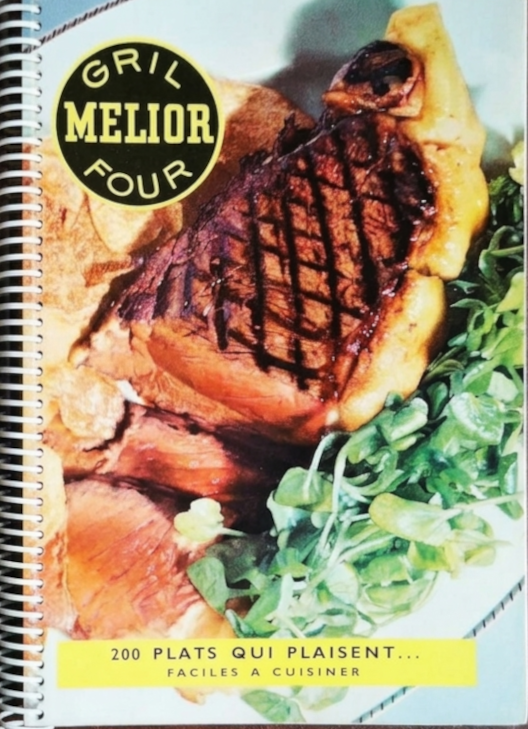
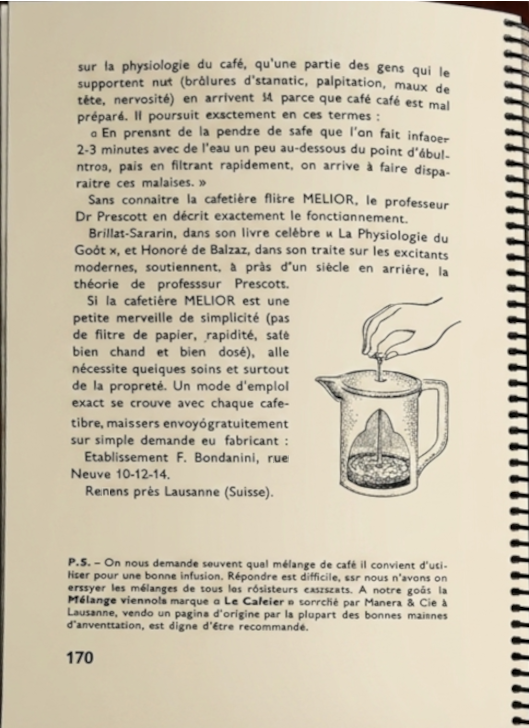
A Melior Gril Four recipe booklet printed in Switzerland from 1952 illustrates the connection between Melior Gril Fours, cafetières and Faliero Bondanini. The booklet celebrates the 20th anniversary of the Melior Gril, presumably referring to an original design by the Moneta company of Milan in 1932. The passage describes how the mission since 1932 had been to promote healthy cooking by preserving vital nutrients and making food easier to digest through avoiding excess fats. It concludes with a quote from Dr. Raoul Blondel, stating that good cooking should be both a science (healthy and balanced) and an art (pleasurable and joyful).
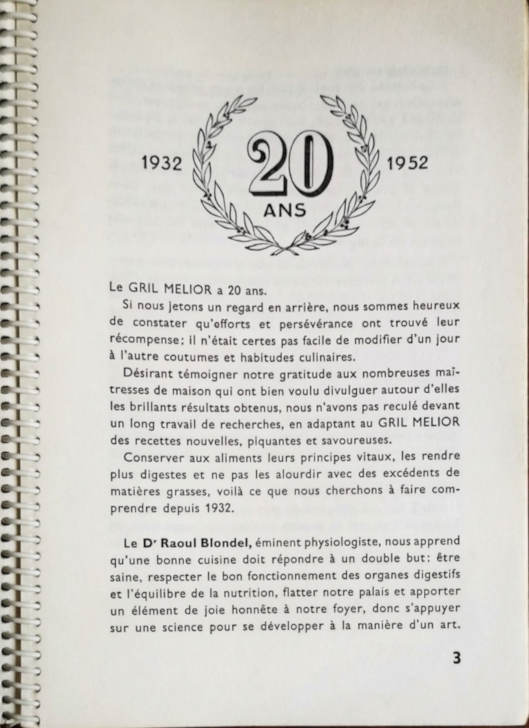
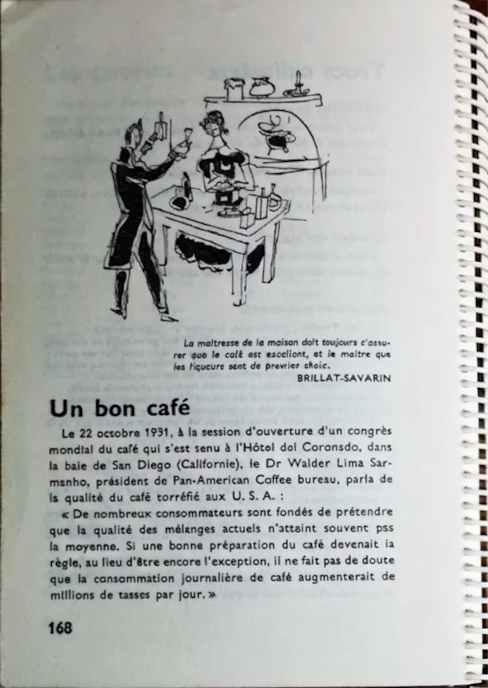
Towards the back of the recipe booklet there are pages that describe the other Melior product, the cafetière. The text describes a coffee conference in California where concerns about the quality of coffee at the time were aired.
Note the cartoon and reference to a nineteenth century gastronome Brillat-Savarin which translates as:
“The mistress of the house must always make sure that the coffee is excellent, and the master that the liqueurs are of the first choice.”
Whilst the sentiment of the reference to Brillat-Savarin sounds a little old fashioned today, it does serve to connect this booklet to the advertising activity of SFC, which also refers to the eighteenth century gastronome Brillat-Savarin. (The following example from 1952).
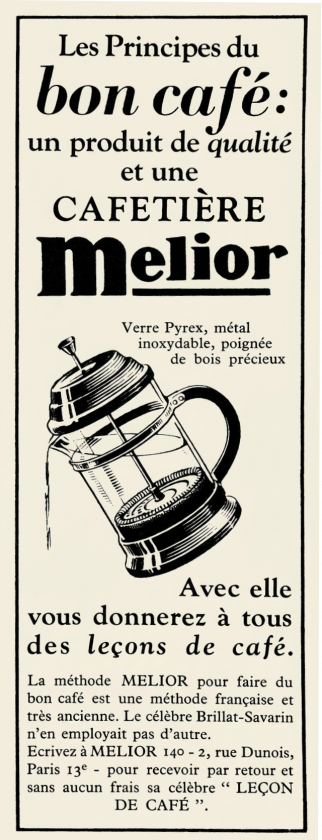
The text goes on to present the Melior cafetière in its best light, translated as follows:
“If the MELIOR coffee maker is a little marvel of simplicity (no filter paper, fast brewing, perfectly hot, flavoursome coffee), it requires some care and above all cleanliness. An exact instruction manual can be found with each coffee maker, but will be sent free of charge on request to the manufacturer: Établissement F. Bondanini, rue Neuve 10-12-14, Renens near Lausanne (Switzerland).”
Melior SA – a Swiss manufacturer of cafetieres and cooking grills
The relationship between Faliero Bondanini and SFC/ Martin SA lasted until 1963 when he set up a new company in Lausanne, Switzerland. He had legal rights to use the Melior name, and his own company was registered as Melior SA, also selling cafetieres and cooking grills. Bondanini and his son Mario are recorded in a business periodical ‘Opera Mundi Europe’ (October 1965) as having a well-known cooking grill and cafetiere business.
Patent registrations filed by Faliero Bondanini in the 1960s and 1970s are mostly connected to technical improvements for cooking grills. There are also examples of recipe books for barbecuing and grilling – an indication that Melior SA had a more active commercial interest in the newly fashionable activity of barbecuing.
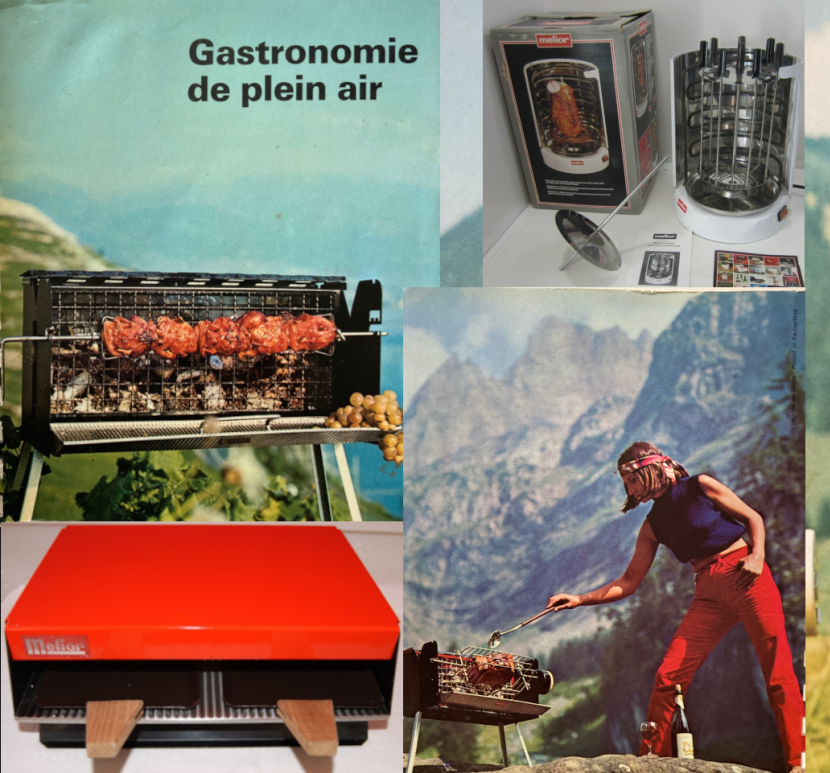
Imagery of Melior SA (Switzerland) products and printed materials c. 1970’s and later
There is also a continued interest in cafetieres with a registered patent for improvements to the filter design in February 1975. In this patent the different parts of the filter set are reduced to a single component. There are the familiar ‘tongues’ with a specification that these may be made from plastic. The single piece was intended to save time when the user was cleaning the filter and would also reduce manufacturing cost. However, whether this filter design was ever successfully marketed is not known. As late as 1984 there is a final Faliero Bondanini application for ‘a filter for the filtering and preparation of infusions’ this registration made with the Japan patent office.
Mario Bondanini became the owner and managing director of Melior SA in 1981 and the business prospered with Swiss distribution agreements made with German housewares manufacturers Rowenta and also Brita in 1984. He eventually sold the business in 1998 and retired in 2000 [Ref].
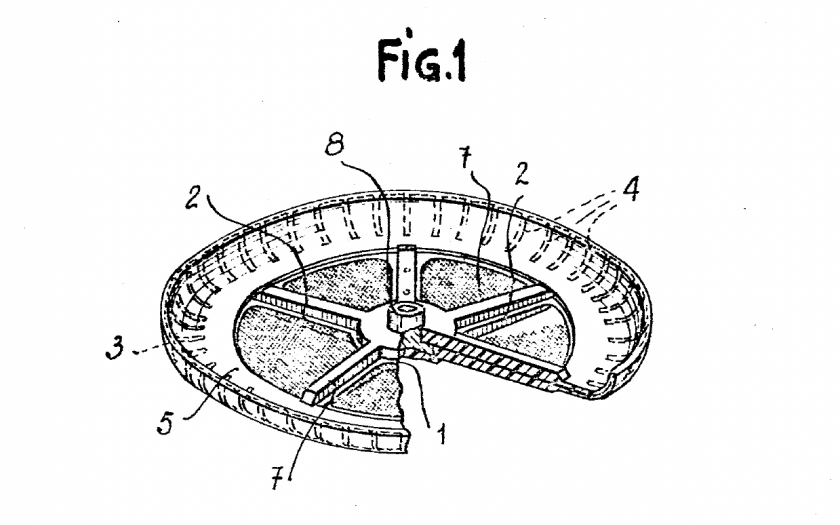
Image extract from: Filter for infusion apparatus
Patent number FR 2 300 532
Faliero Bondanini
Application registered 13.02.1975
Faliero Bondanini clearly deserves recognition as an influential force in the history of the cafetiere French press, driving its popularity in France and Switzerland. He was a pioneer in recognising its potential as a simple and elegant way of making coffee at home. As early as 1934 he was operating as a sales agent and marketing Moneta Melior cafetières and grills in Switzerland. After the Second World War, he was closely involved in championing Melior branded products, this time connected to a French company SFC and also Établissements F. Bondanini in Switzerland. He was involved in the first use of heatproof, borosilicate glass in cafetiere design and the development of the typical form of a tall, glass coffeemaker. He also patented an alternative filter arrangement that had the potential to improve on the Moneta/Cassol design, however that it did not supersede the earlier Gemma Moneta/Cassol design.
1965 The Ipcress File, Michael Caine and fame for the cafetiere?
In the opening scenes of the Ipcress File Harry Palmer is seen preparing fresh coffee using an electric grinder and a coffeemaker that looks very much like a cafetiere.
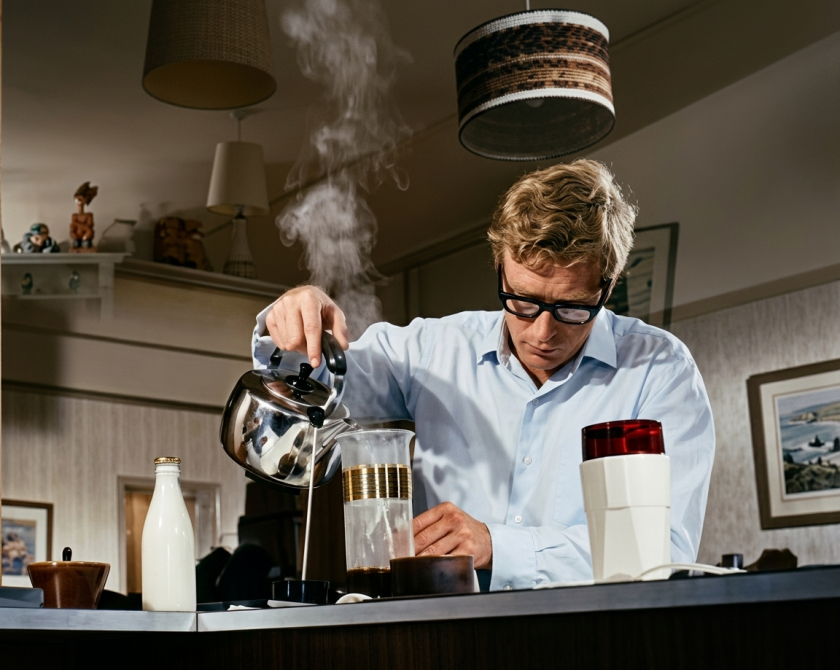
Image of Michael Caine as Harry Palmer in the opening credit sequence from The Ipcress File. 1965. Sidney J. Furie (Director) Harry Saltzman (Producer)
The coffeemaker is actually an American Boonton Insta-Brewer (patent filed April 1965, US3307474A) that was similar to a cafetiere, but the filter mechanism also included a device for removing the spent coffee grounds at the end of the operation.
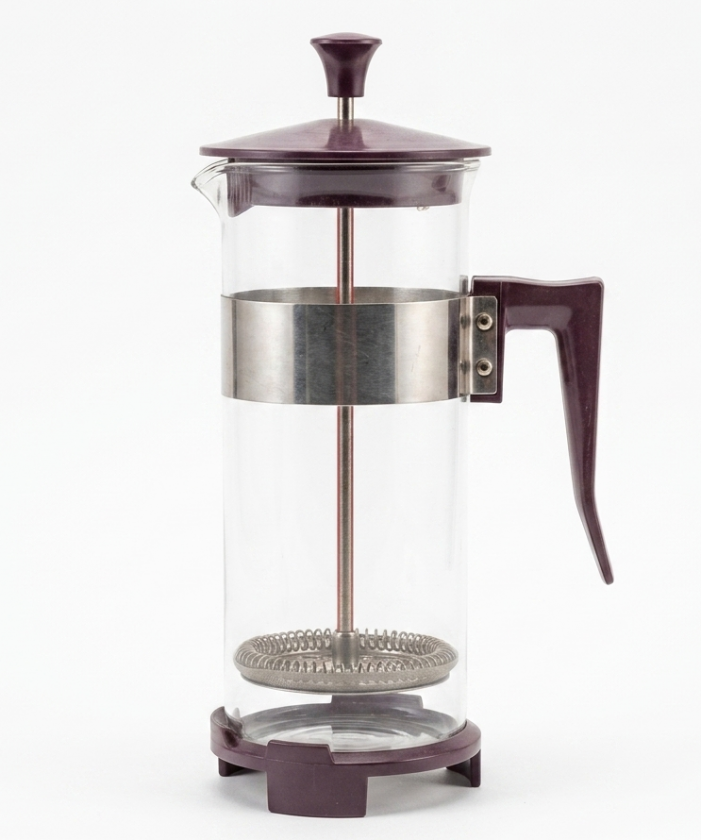
The 1970’s – the rise of convenience and affordable kitchen electricals
Rather than the cafetiere coffeemaker, it was the electric coffee grinder also shown in the Ipcress File that was most indicative of future trends, as during the late 1960’s and into the 1980’s small kitchen electricals became very popular. The 1970’s saw the rising popularity of electric percolators, electric filter machines amongst other time saving electricals.
In France and Italy, the countries of origin, cafetieres declined in favour almost completely for different reasons; in the case of Italy because of the success of the Bialetti Moka pot becoming the nation’s favourite coffeemaker. And in the case of France, electric coffee machines that incorporated the function of heating water were far more convenient as many households did not possess an electric kettle.
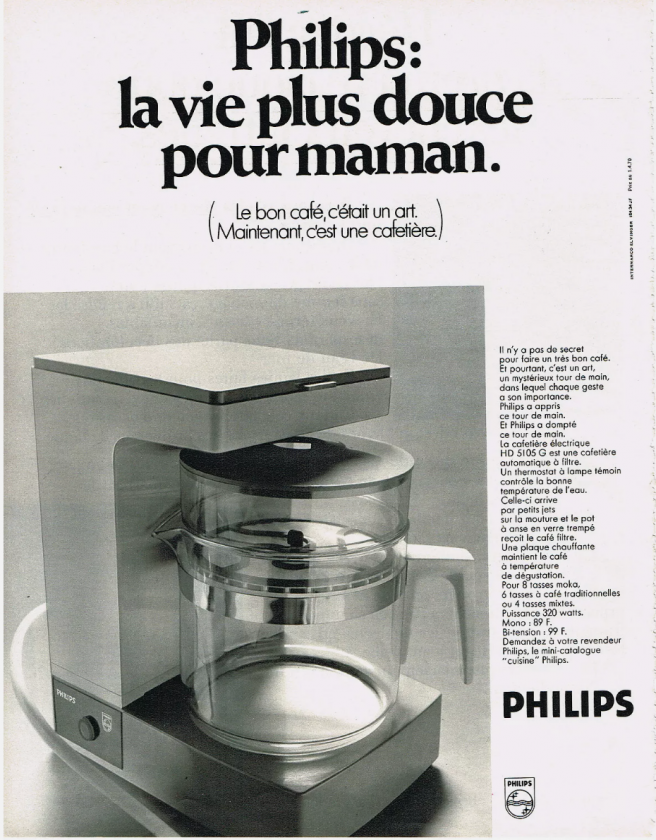
Image of an electric filter coffeemaker in a French advert from 1970
By the mid 1970’s there were a handful of brands selling cafetieres including Melior France with international sales in the USA and UK. La Cafetiere [Ref] marketed a similar looking coffeemaker mostly selling in the UK and Australasia. The Boonton Insta-Brewer seems to have stopped production before the end of the 1970’s. For a time cafetieres seemed to be a more niche product for enthusiasts rather than the mainstream; a product found in small ads and specialist retailers.
However, it is significant that in 1974 Bodum, the Danish housewares company, launched its first cafetiere; the Bodum Bistro [Ref].
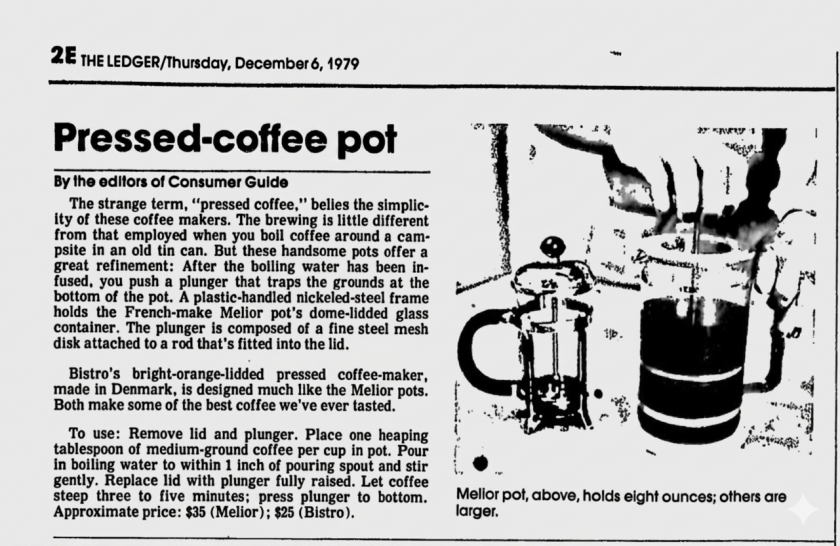
Melior and Bodum Bistro, advertised in Lakeland Ledger 1979 (Florida USA)
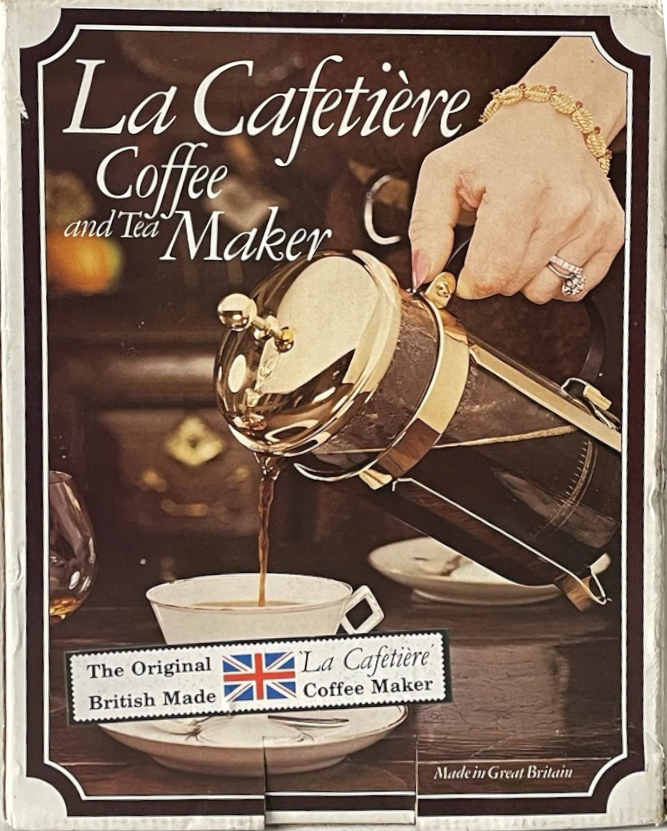
An example of a La Cafetière coffeemaker (UK c.1990)
Waves of progress measure the dynamic change in coffee consumption
In the early 1980’s consumers who enjoyed coffee would most likely choose instant coffee for everyday convenience and some also enjoying the superior quality of electric filter or percolator coffee on occasion. The instant coffee brands were major advertisers and storylines and taglines of TV adverts could hold the attention of the nation (the Nescafe Gold Blend couple in the UK, Maxwell House ‘good to the last drop’ tagline in the USA).
Whilst instant still dominates volume sales of coffee, there have been a series of waves in the evolution of coffee consumption moving towards greater quality. The First Wave being increasing accessibility and convenience (instant coffee to electric filters and percolators). The Second Wave was the development of ‘coffee shop culture’ and an emphasis on quality and speciality beverages; a key moment was on 30th March 1971 when Starbucks opened its first speciality store in Seattle, then only retailing coffee beans. By 1986 there were 6 Starbucks stores in Seattle with expansion outside of the city in 1987. By comparison, Costa Coffee in the UK opened its first coffee shop in London in 1981, expanding out of its roastery business started in 1971. Today there are over 65,000 coffee shops in the USA and more than 12,000 coffee chain stores in the UK.
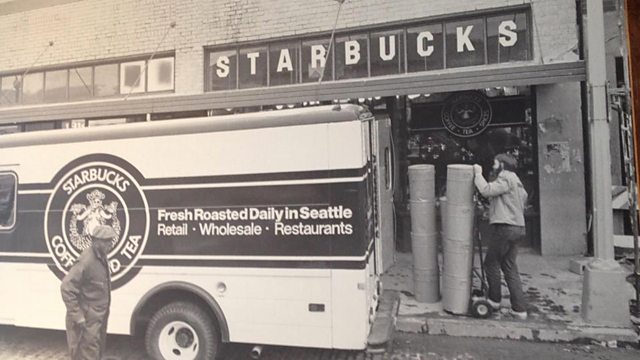
The 1980’s and a renaissance for the cafetiere
The growth of coffee shops and quality coffee during the 1980’s indicates growing consumer tastes for fresh quality coffee or ‘real coffee’. In an article dated January 16th 1986, the Los Angeles Times reviews two types of coffeemaker; an electric espresso maker (Vivalp V50 Espresso Plus) and the Melior manual coffeemaker. The article indicates that this style of coffeemaker is increasingly popular, and assumes little prior knowledge among its readers:
The operation is fuss-free: Place the desired amount of ground coffee into the cylinder, add the appropriate amount of boiling water and allow to steep for 3 to 5 minutes (depending upon taste for weaker or stronger coffee). Then slowly depress the plunger to the bottom. The fine-mesh screen separates the coffee grounds from the drink, which, by this time, has all the flavor and aroma you would want in your coffee.”
In this article the Melior coffeemaker is not referred to as a ‘French press’ at this date, although it is closely connected to France. Melior cafetieres had ‘Made in France’ prominently marked on the glass beaker at this time and perhaps ‘French press’ became a general reference for this type of coffeemaker sometime later simply as a convenient reference as it was written on the side of the glass?
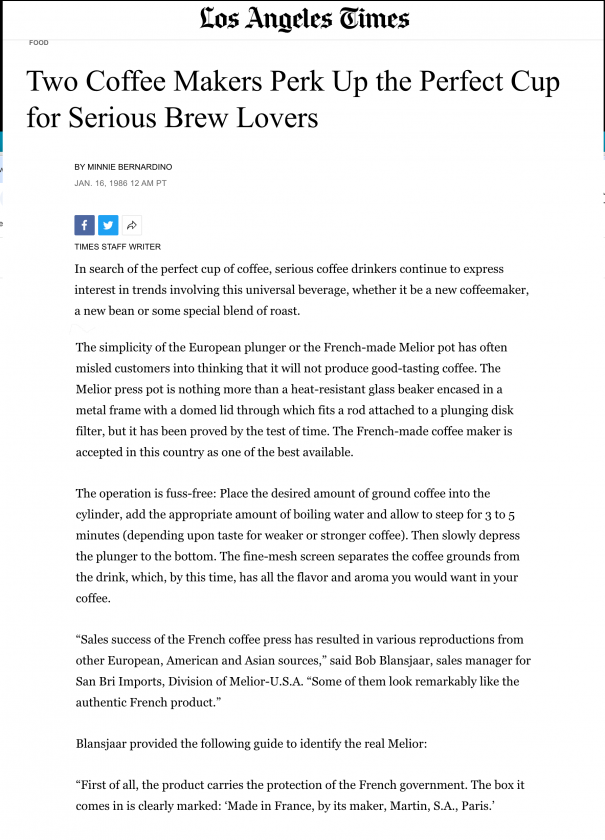
Extract from Los Angeles times online article 01.16.1986 by Minnie Bernadino
The 1990’s and an explosion in consumer tastes for quality coffee, shops, capsule machines … and cafetières too
In the 1990’s consumer appetite for fresh coffee at home or the workplace grew rapidly alongside the growth in coffee shops. In the USA Melior and Bodum becoming very well known French press brands; in the UK, La Cafetiere and Bodum the better known makes. In August 1991 the parent company of Bodum bought the Melior business from Martin SA [Ref]. The well-known Melior glass cafetiere once again took on the ‘Chambord’ name to differentiate it from Bodum’s other cafetiere coffeemakers. The Melior trademark remained in use for Bodum coffee and tea related products in some markets including the USA.
In the 21st century the trend has been further towards quality, artisanal craft, traceability and sustainability (the Third Wave). Coffee shops have become one of the most common retailers in urban areas around the globe. There has also been the growth of a new segment – coffee capsule or pod machines. Nespresso, founded in 1986 [Ref], grew slowly at first and now these machines sit in roughly a quarter of all households in the UK.
The cafetiere / French press – moving into the future
The popularity of the cafetiere or French press continues despite the multiplicity of different ways of consuming coffee these days. The key to the success of the coffeemaker is combining simplicity in operation; quality in the coffee experience and price.
The different innovators in the development of this coffeemaker, from Attilio Calimani and Giulio Moneta, to Gemma Moneta and Bruno Cassol, Faliero Bondanini and others, have collectively created a timeless device that offers the coffee lover freedom in the coffee they select, freedom to make at home, in the office or the great outdoors and at a cost that is affordable for almost all.
Just one thing … the problem of cleaning
Cafetieres have many advantages – but cleaning out the used grounds after use is a chore. There have been a number of solutions to this messy issue over the years. The 1964 Boonton Insta-Brewer incorporated a device to lift out the grounds after use (a disc below the filter). There have been cups inserted into the cafetiere beaker to collect the grounds (La Cafetière Groundhog) or attached by magnets to the filter itself (Tambaroo French Kiss). Today the Espro brand has a filter basket rather than a disc, that incorporates the grounds and La Cafetière have a model with a removeable base allowing the waste to be pushed out of the bottom of the beaker.
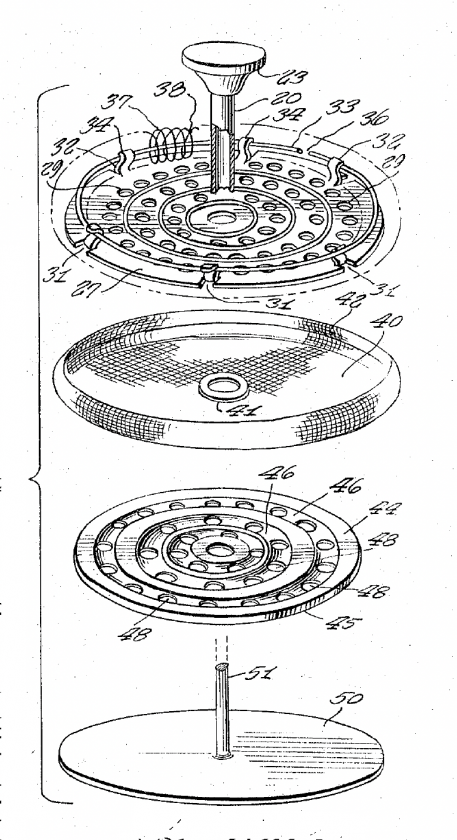
Image extract from: Coffee Brewing Apparatus with means for removing used coffee grounds
Patent number USA 3,307,474
Charles Kasher (assignor to Boonton Molding Co Inc)
Application registered 14.04.1965
My interest in the cafetiere started with thinking about a way to solve this cleaning issue. Rather than changing the cafetiere itself, I devised a utensil that takes advantage of the cylindrical shape of the cafetiere. Scoof is a coffee stirrer during preparation and then doubles up as a handy cleaning tool. It works rather well – although I say so myself!
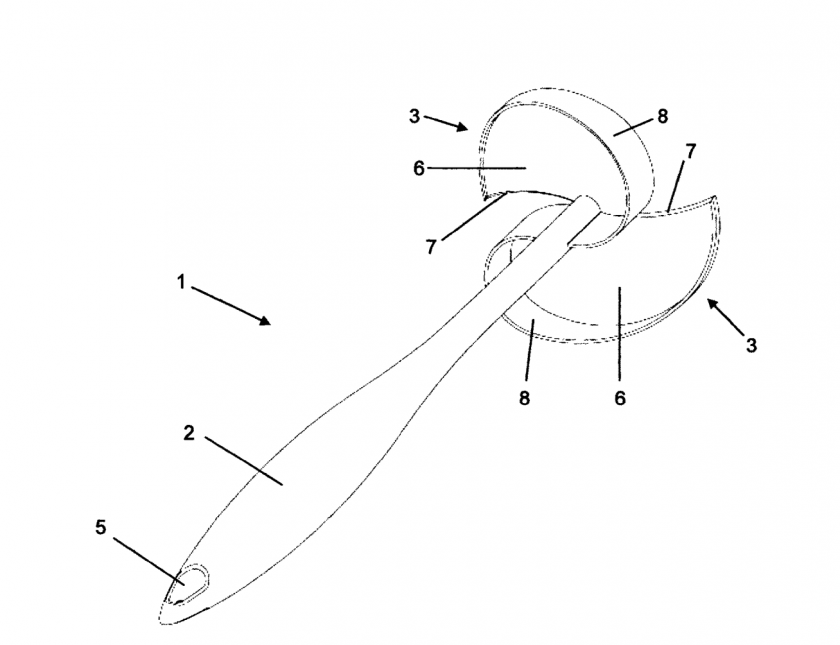
Scoof. A tool for removing coffee grounds from a coffee maker
Design Registration UK 6004947
Joe Partridge
Application registered 21.12.2016
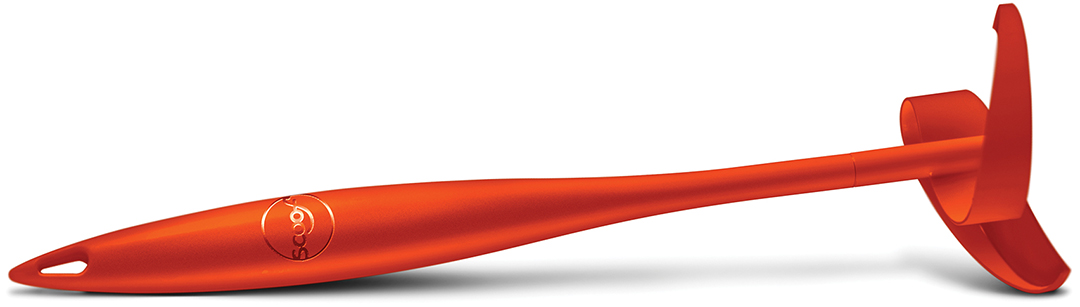
…. and you can shop for a Scoof here!


.jpg)
